Friendly Name: Grand fir
Latin Name: Abies grandis
Other Name: lowland white fir, great silver fir, western white fir, Vancouver fir Oregon fir
Description: From Wikipedia:
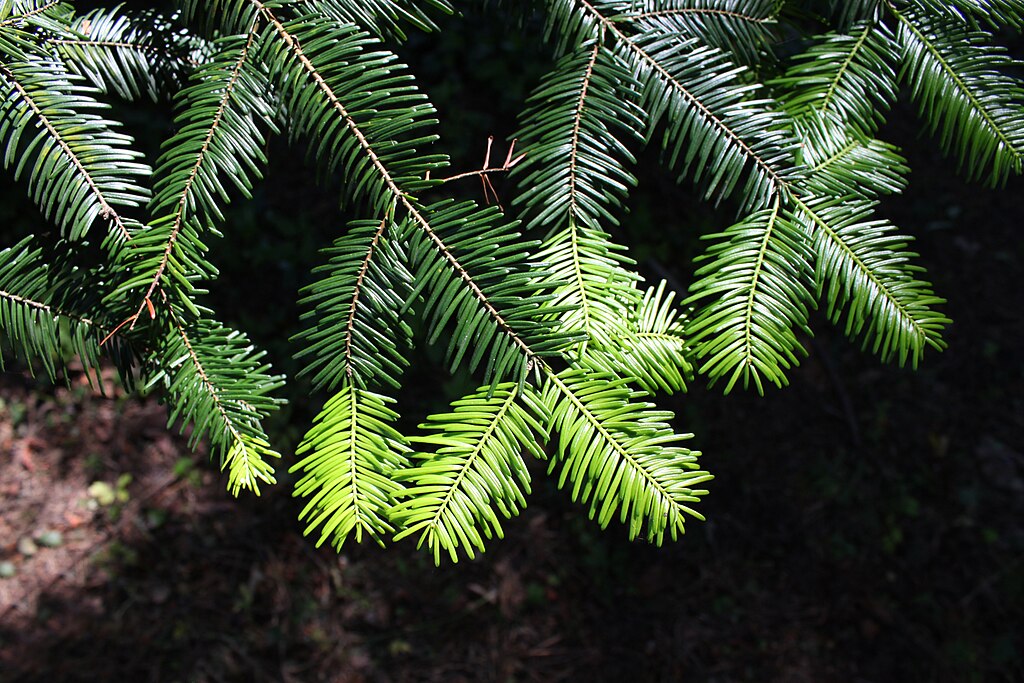
Abies grandis is a large evergreen conifer growing to 40–70 metres (130–230 feet) tall, exceptionally 100 m (330 ft), with a trunk diameter of up to 2 m (6+1⁄2 ft). The dead tree tops sometimes fork into new growth.[4] The bark is 5 centimetres (2 inches) thick, reddish to gray (but purple within), furrowed, and divided into slender plates.[4] The leaves are needle-like, flattened, 3–6 cm (1+1⁄8–2+3⁄8 in) long and 2 millimetres (3⁄32 in) wide by 0.5 mm thick, glossy dark green above,[4] with two green-white bands of stomata below, and slightly notched at the tip. The leaf arrangement is spiral on the shoot, but with each leaf variably twisted at the base so they all lie in two more-or-less flat ranks on either side of the shoot. On the lower leaf surface, two green-white bands of stomata are prominent. The base of each leaf is twisted a variable amount so that the leaves are nearly coplanar.
ID Tips: Needles:
- Flat
- Glossy green on top
- Two green-white bands of stomata on bottom
- Notched at the tip
- arranged on the stem in nearly a co-planar arrangement
Cones:
- whole cones are hard to find becuase they disentegrate and drop wing-like seeds.
- Look for the individual seed bracts on the ground.
Distribution: The coastal variety of grand fir grows in temperate rainforest environments along the Pacific coast from southwest British Columbia to Northern California, with the inland variety growing in montane conifer forests of eastern Washington, the Idaho Panhandle, and far western Montana. It can be found growing at elevations of up to 1,700 m (5,600 ft).[4] Habitats typically receive at least 640 mm (25 in) of annual rainfall, but are still too dry or outside the range of more shade-tolerant competitors like western hemlock and western redcedar.[4] Along with the closely related white fir, grand fir is more shade tolerant than Douglas-fir.[4]
There are two varieties, probably better treated at subspecies rank though not yet formally published as such:
- Abies grandis var. grandis. Coast grand fir. Coastal lowland forests, at sea level to 900 m altitude, from Vancouver Island and coastal British Columbia, south to Sonoma County, California. A large, very fast-growing tree to 70 m tall. Foliage strongly flattened on all shoots. Cones slightly narrower (mostly less than 4 cm broad), with thinner, fairly flexible scales. Tolerates winter temperatures down to about -25° to -30 °C; growth on good sites may exceed 1.5 m per year when young.[1]
- Abies grandis var. idahoensis. Interior grand fir. Interior forests, at (600–) 900–1800 m altitude, on the east slope of the Cascades in Washington and in the Rocky Mountains from southeast British Columbia south to central Idaho, northeast Oregon and western Montana. A smaller, slow-growing tree to 40–45 m tall. Foliage not strongly flattened on all shoots, the leaves often raised above the shoot, particularly on upper crown shoots. Cones slightly stouter (mostly over 4 cm broad), with thicker, slightly woody scales. Tolerates winter temperatures down to about -40 °C; growth on good sites not exceeding 0.6 m per year even when young.[1]
Grand fir is very closely related to white fir (Abies concolor), and intergrades with it in central Oregon. Firs of the Blue Mountains and Oregon East Cascade Slope are intermediate between the two species in genetics and appearance. The intergrades are often referred to as “Abies grandis x concolor”, a variety which itself intergrades into Abies concolor lowiana farther south, around the California state line.[5][6][7]