
Mushroom foragers in Oregon – and many other states – have to navigate a plethora of rules, regulations and permits to stay “legal.”

The rules differ based on who owns the land (local, state of federal), the type of mushroom (matsutake and truffles have special rules) and how much volume you intend to pick. Ultimately, foragers should do their own research before picking.
Learn below about all the different rules and regulations in the State of Oregon, depending where you hunt. Probably the most important rule to honor is private property: never trespass to collect mushrooms.
Please comment (at the end) if you think one of these is wrong or out of date and we will research and correct!
Oregon has 9 National Forests, here is a quick overview of differences in foraging rules
- Deschutes, Willamette, Fremont-Winema and Umpqua share a permit and common set of rules.
- Malheur, Wallowa-Whitman and Umatilla share a permit and common set of rules.
- 5 forests require permits for free personal use with an allowance of 2 gallons per day (for a total of 10 days only): Deschutes, Willamette, Fremont-Winema, Umpqua and Ochoco.
- 5 forests support free picking with no permit with an allowance of only 1 gallon per day: Malheur, Wallowa-Whitman, Umatilla, Mt. Hood and Siuslaw.
- 5 forests require free/personal use permits and require the forager to cut mushrooms in half: Deschutes, Willamette, Fremont-Winema, Umpqua and Ochoco.
- Only one (1) forest requires a permit that charges by weight of mushrooms harvested (the rest do a date range): Mt Hood.
- Can you pick in Oregon Wilderness? Deschutes, Willamette, Fremont-Winema and Umpqua allow, but only for on-site use. Malheur, Wallowa-Whitman and Umatilla allow up to 1 gallon for personal use. The others appear to prohibit all picking.
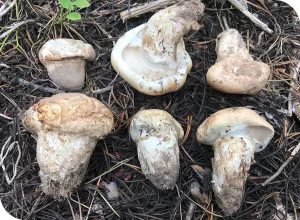
- Nearly every forest has specific matsutake permits where the matsutake typically cannot be picked at all without a permit. Siuslaw allows up to 6 matsutake per day picked for personal use, but they must be cut in half.
- Commercial picking in Wilderness areas is forbidden across the state.
Individual Forest Rules
Deschutes National Forest
- Permits and Mushroom Harvesting Details
- Permit shared with Fremont-Winema, Umpqua & Willamette National Forests
- Personal Picking: Permit required. Allowance up to 2 gallons per day (totaling 10 days a year only) and mushrooms must be cut in half lengthwise, stem through cap, with both halves separated at the time of harvest.
- Commercial permit (or personal over 2 gallons per day), permit required. $20 for 10 days, $100 for entire season.
- Each forager must have a valid permit (and be 18 years or older).
- A harvest area map must be in your possession to gather, transport or sell mushrooms gathered.
- Commercial mushroom picking is prohibited within: Crater Lake National Park, Newberry National Volcanic Monument, H.J. Andrews Experimental Forest, Late Successional Reserves, Research Natural Areas, Wildernesses, Developed Recreation Areas and other designated non-harvest areas.
- Restricted areas, special maps and information
- Matsutake require a special commercial permit to pick and harvest for resale. Permits cost $200 for the 62-day season, $100 for a half-season permit (valid for 31 consecutive days) or $8 per day with a three-day minimum purchase (picking days do not need to be consecutive). Harvesters must be 18 years of age or older and have a valid ID to purchase a permit.
- Commercial Matsutake Harvesting Synopsis (2025) – Season 09/2/25 – 11/3/25
- Wilderness rules: Deschutes has six Wilderness areas: Mount Jefferson Wilderness, Mount Thielsen Wilderness, Mount Washington Wilderness, Three Sisters Wilderness, Diamond Peak Wilderness, and Badger Creek Wilderness.
- Wilderness Regs say: Commercial picking and “gathering of forest products, for example mushrooms and berries, except for personal on-site use” is prohibited.
Fremont-Winema National Forest
- Same as Deschutes outlined above (and Willamette & Umpqua) with a shared permit, except:
- A harvest area map is not required on your person on the Fremont half (or the East half) of the Fremont-Winema National Forest.
- Wilderness rules: Gearhart Mountain Wilderness, Mountain Lakes Wilderness, and Sky Lakes Wilderness should match Willamette’s rules below – only for “personal on-site use”.
Malheur National Forest
Malheur is part of the “Blue Mountain Forests’ Mushroom Program” and shares permits with Wallowa-Whitman and Umatilla National Forests. They have a specific shared Mushroom Harvesting Guide.
- Incidental picking requires no permit and is limited to 1 gallon per person per day.
- A permit is required for commercial or personal picking over 1 gallon (harvesting, possessing or transporting more than 1 gallon, technically).
- Commercial pickers must be 18 or older
- Commercial mushroomers are required to keep a record of the date, time and number of gallons removed off National Forest Lands on the Product Quantity Removal Record located on the front of their mushroom permit.
- Commercial permit is $2 per day (10 day minimum), annual for $100.
- Wilderness rules: Malheur has three Wilderness areas – Strawberry Mountain Wilderness, Monument Rock Wilderness, and North Fork Malheur. Malheur specifically prohibits commercial picking in Wilderness areas, but interestingly the “Blue Mountain Forests” (whose umbrella includes these three Wilderness areas) do allow 1 gallon of mushrooms to be picked for personal use per this resource.
Mount Hood National Forest
Permits and Mushroom Harvesting Details
-
- Incidental Picking requires no permit and is limited to 1 gallon per person per day. Read the 2023 Mt. Hood incidental use rules.
- Mount Hood has special picking areas dictating where mushroom gathering is allowed for personal use:
- All mushroom picking is prohibited within: research areas, wilderness, developed recreation areas, riparian areas/near rivers and streams, and other designated non-harvest areas.
- A permit is required for commercial or personal picking over 1 gallon per day (harvesting, possessing or transporting more than 1 gallon, technically)
- Commercial permits cost $1 per gallon (20 gallon minimum purchase) for non-matsutake mushrooms, $4 per gallon (5 gallon minimum purchase) for matsutake.
- Commercial picking is limited to specific areas per this digital map – permit holders will receive a paper copy when they purchase the commercial permit.
- Commercial pickers must be 18 or older.
- Wilderness Rules: I could find no guidance on Mt. Hood’s wilderness rules for: Badger Creek Wilderness, Bull of the Woods Wilderness, Mark O. Hatfield Wilderness, Salmon-Huckleberry Wilderness, Clackamas Wilderness, Roaring River Wilderness, Lower White River Wilderness, Mount Hood Wilderness, Salmon-Huckleberry Wilderness, Twin Lakes Wilderness, or Roaring River Wilderness. I would assume you can only pick mushrooms to be consumed on-site in these areas.
- Incidental Picking requires no permit and is limited to 1 gallon per person per day. Read the 2023 Mt. Hood incidental use rules.
Ochoco National Forest
Permits and Mushroom harvesting Details
- Personal Use Free Permit (“free mushroom permit”): Up to 2 gallons per day, must be cut in half lengthwise at the time of harvest. There is no cost for this permit.
- Commercial harvest for over 2 gallons per day; no details on pricing available.
- Wilderness Rules: prohibit the collection of mushrooms. Ochoco has three Wilderness areas – Black Canyon Wilderness, Bridge Creek Wilderness, and Mill Creek Wilderness.
Rogue River-Siskiyou National Forest
- No permit required for incidental use amounts (likely 1lb, but unsure – please verify yourself), for non-matsutake.
- Commercial permit details and pricing: none available online.
- Matsutake: A permit must be obtained prior to removing any amount of American Matsutake mushrooms. Only the fruiting body may be harvested, with care being taken to not damage mycelium.
- Wilderness Rules: I found no information about mushrooms in any of the Wilderness areas inside Rogue River-Siskiyou – Copper Salmon Wilderness, Kalmiopsis Wilderness, Wild Rogue Wilderness, Grassy Knob Wilderness, Red Buttes Wilderness, Siskiyou Wilderness or Sky Lakes Wilderness.
Siuslaw National Forest
- No permit required for harvesting one gallon or less per day of non-matsutake. Matsutake are limited to 6 per person per day and must be cut in half immediately upon picking.
- Commercial permit required for more than 1 lb of non-matsuake per day.
- Each mushroom picker must have a valid permit and be age 18 or older.
- 10 days for $20, 30 days for $40, Annual permits for $100.
- Only certain mushrooms may be commercially harvested: Chanterelles, Boletus, Oyster, Sulfur Shelf Fungus, Slippery Jack, Imperial (Catathelasma), Hedgehog, Shaggy Mane, Lobster, Cauliflower, Pigs Ear and Coral fungus.
- Matsutake permit: Only 100 permits per year are sold within the Central Coast Ranger District for $250 each. Permits typically become available in late summer/early fall.
- Wilderness Areas: harvesting is prohibited. No guidance provided about mushrooms (or berries) for the following areas: Cummins Creek Wilderness, Rock Creek Wilderness, or Drift Creek Wilderness.
Umatilla
- Umatilla is part of the “Blue Mountain Forests’ Mushroom Program” and shares permits with Malheur and Wallowa-Whitman National Forests. They have a specific shared Mushroom Harvesting Guide.
- Wilderness Rules: follow the same rules as Malheur. There two Wilderness areas in Umatilla: Wenaha-Tucannon Wilderness and Boulder Creek Wilderness.
Umpqua National Forest
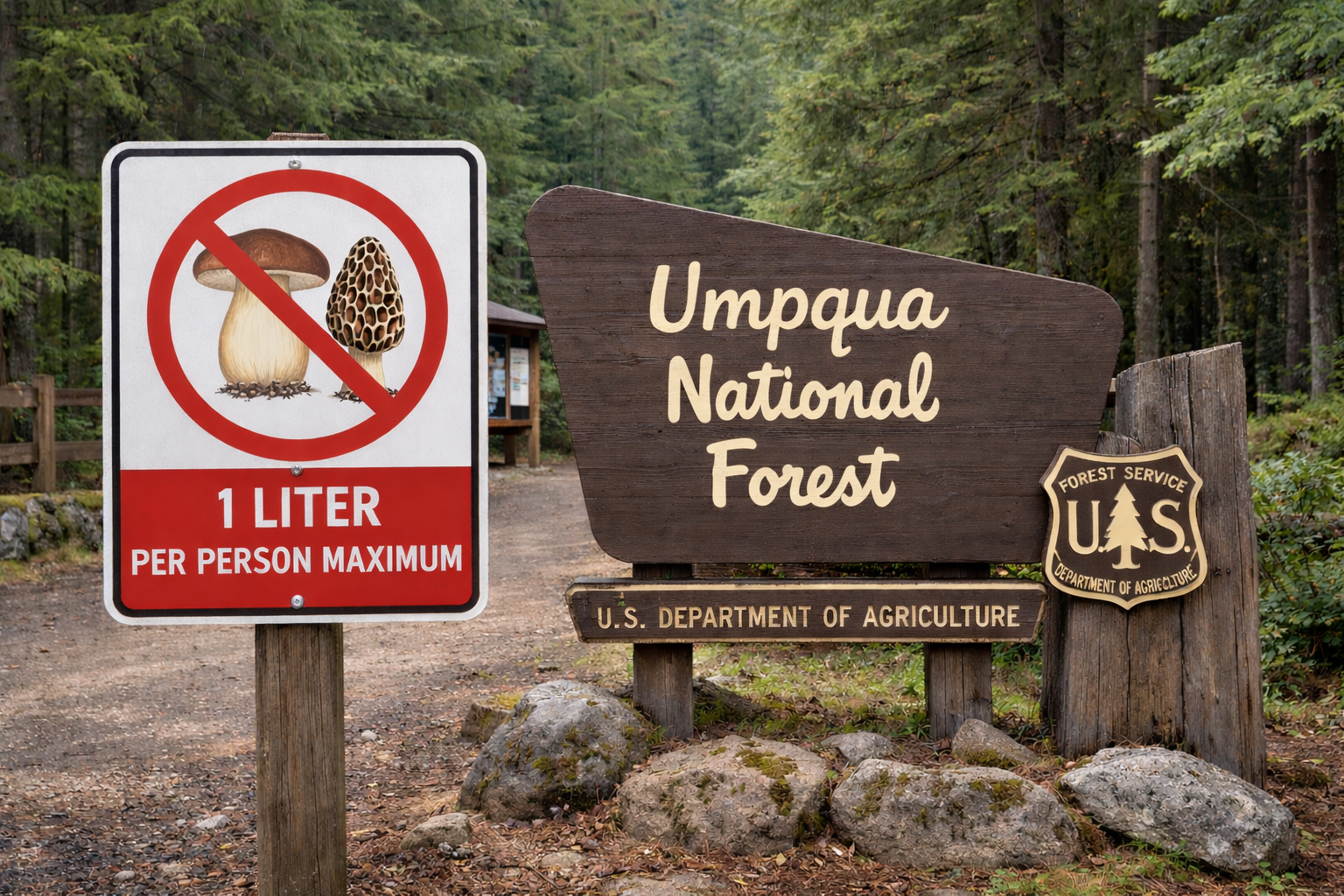
- Permit shared with Deschutes, Fremont-Winema & Willamette BUT three additional regulations apply:
- At least one-third of the mushroom caps on the collection area (of the same species as being collected) should be left intact to release spores (FW-337);
- No harvest of truffles is allowed,
- No commercial collection of mushrooms will be allowed in “Late Successional Reserves”; and on both the Umpqua and Willamette N.F’s. No harvest within riparian areas (any stream [Class 1 thru 4], ponds or wet areas).
- In addition to the four-forest mushroom permits, the Umpqua National Forest also offers free-use matsutake permits. These permits allow permittees to harvest 15 mushrooms a day for up to 10 days of matsutake mushrooms in the Umpqua National Forest only.
- Wilderness Rules: unknown for Boulder Creek Wilderness, Mount Thielsen Wilderness and Rogue-Umpqua Divide. Commercial picking is prohibited elsewhere.
Wallow-Whitman National Forest
- Wallow-Whitman is part of the “Blue Mountain Forests’ Mushroom Program” and shares permits with Malheur and Umatilla National Forests. They have a specific shared Mushroom Harvesting Guide.
- Wilderness Rules: follow the same rules as Malheur. Wallowa-Whitman National Forest has four wilderness areas: Eagle Cap Wilderness, Hells Canyon Wilderness, North Fork Umatilla and Monument Rock Wilderness. This appears to be 1 gallon of personal use allowed; no commercial picking.
Willamette National Forest
- Permit shared with Deschutes, Fremont-Winema & Umpqua BUT three additional regulations apply;
- At least one-third of the mushroom caps on the collection area (of the same species as being collected) should be left intact to release spores (FW-337);
- No harvest of truffles is allowed,
- No commercial collection of mushrooms will be allowed in “Late Successional Reserves”; and on both the Umpqua and Willamette N.F’s. no harvest within riparian areas (any stream [Class 1 thru 4], ponds or wet areas).
- The Matsutake mushroom season starts the day after Labor Day each year and lasts for 60 calendar days. Free collection of Matsutake mushrooms is not permitted in all four participating forests (Deschutes, Fremont-Winema, Umpqua, & Willamette National Forests). Harvesters wishing to gather Matsutake mushrooms must obtain a day-use permit (minimum of 3 days, not required to be consecutive), a half-season permit, or a full-season permit for their activities.
- Wilderness Rules: unknown for Boulder Creek Wilderness, Mount Thielsen Wilderness and Rogue-Umpqua Divide. Commercial picking is prohibited elsewhere.
State Land
Thanks to Cascade Mycological Society for summarizing the state land foraging rules succinctly:
Oregon State Forest Lands: If collecting for personal use, no permit is required for Oregon Department of Forestry lands managed by the Astoria, Tillamook, Forest Grove, North Cascade, or West Oregon Districts; this includes the Santiam, Tillamook, and Clatsop State forests. The limit for personal use is one gallon or less per vehicle for mushrooms and one quart or less per vehicle for truffles. Reference link. Gilchrist and Sun Pass State forests in the Klamath district (TBD, 541-935-2283), For all other State Forest Lands, abide by all posted signage.
Oregon State Parks and Recreation Areas: Oregon state law 736-010-0055 states, “Unless otherwise posted a person may gather for personal consumption of berries, fruits, mushrooms, or similar edibles in quantities not to exceed one gallon per person per day.” Source
Truffles
Rules for truffle harvesting also vary, but tend to be extra stringent. There are special requirements dictating where truffles can be harvested and also limiting hunters to trained truffle dogs. Special permits, detailed records and harvest restrictions also apply. It is worth noting that a special Oregon Law (House Bill 2615) specifically regulates this on both state and private land. Key Regulations under HB 2615:
- Mandatory Permits: All individuals (other than the landowner) must obtain a written permit from landowner to collect wild edible fungi, specifically including truffles, on both private and state-owned forestlands.
- Commercial Tracking: Businesses or individuals that buy wild-harvested truffles in Oregon are required to maintain detailed purchase records to ensure legal origin.
- Environmental Protection: The bill was designed to curb “wild west” harvesting practices that often led to tree root damage and property disputes on private timber farms.
- Landowner Authority: Permission must be granted directly by the landowner, and for state lands, harvesters must follow Oregon Department of Forestry (ODF) permit procedures.
Additional Resources

The Cascade Mycological Society has an excellent post about mushroom hunting permits.
The Central Oregon Mushroom Club also has some good mushroom hunting permit details.
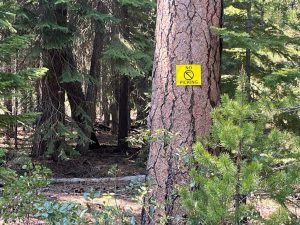
Header image no-picking photo courtesy of Kenneth Watts.
Take a quiz to see what you know – it is a hard one though!